Why Do Astronomers Keep Finding Young Galaxies?

Modern cosmology generally assumes that galaxies formed in the early history of the Universe. Yet astronomical observations continue to identify galaxies that appear surprisingly young despite their location in a supposedly mature cosmos. This article examines that apparent contradiction and explores whether alternative concepts of time, galaxy formation, and cosmological evolution could provide a different interpretation of these observations.
According to Wikipedia, ‘there is currently no satisfactory theory of the emergence and evolution of galaxies’.
Google bridges this theoretical gap quite gracefully.
If we believe in the Big Bang hypothesis, galaxy formation started with neutral gas condensation immediately after the end of the Dark Ages.
This idea is just as handsome as it is incongruous. It means that young galaxies appeared right after the Big Bang and may thus actually exist on the outskirts of our Universe only.
So we search Google for ‘young galaxies’.
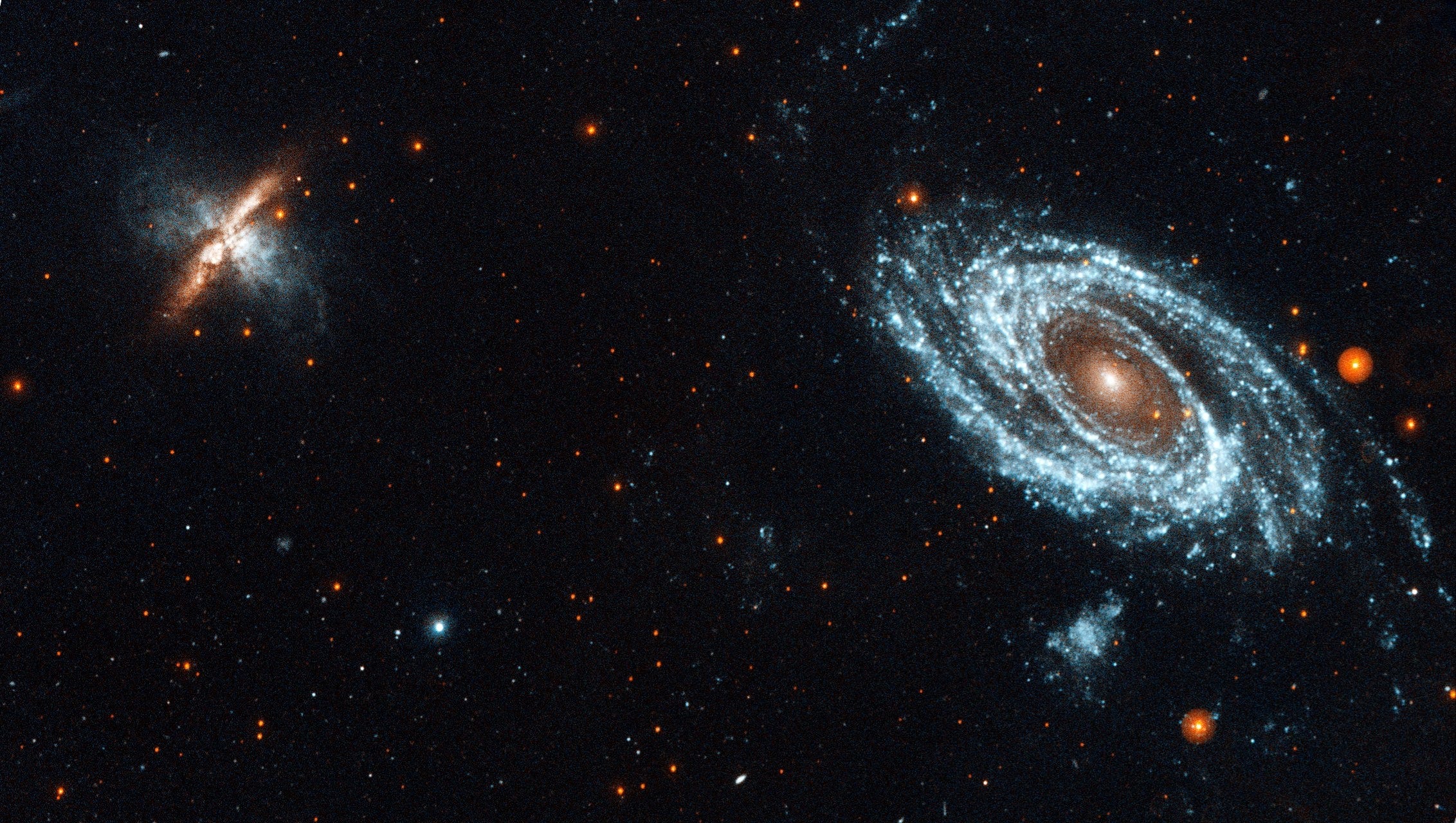
NASA’s Galaxy Evolution Explorer (GALEX) deep space probe found newly emerging galaxies in relative proximity to our Solar system. Out of the thousands of new stellar systems that the spacecraft found two to four billion light years away from the Earth, more than thirty are several times as bright as our Milky Way, which indicates that they are forming actively.
Two billion light years away is by no means the margins of our Universe (the minimum dimensions of the visible Universe are some 14 billion light years), and in the Big Bang perspective those galaxies turn out to be terribly old, aged a minimum of 10 billion years.
So are they young or old ?
We search Google for ‘inverse direction of time’ and see my article about the differences between Bergson’s and Newtonian time (certainly inspired by the famous Cybernetics by Norbert Wiener).
Newtonian time makes no distinction between past and future; in Newtonian time, galaxies may form at any moment if the gravitation parameters are suitable, so the Universe is stationary.
My and the American astronomer Lawrence Schulman’s assumption that the thermodynamic arrow of time is inversely directed in black holes justifies the possibility of hydrogen generation by black holes and the realization of Small Bangs (as Israeli astronomers Alon Retter and Shlomo Heller called the White Holes).
The above position can easily be shown to be the theoretical basis underlying the recent and ongoing birth of new galaxies in the Universe (though in Newtonian time birth is no different from death).
So we conclude that galaxies are born and die like humans, but they NEVER grow old – like ladies.
Thank you for sharing, very interesting read!
I’m not an expert, but this topic has always fascinated me. It’s as if the immensity of the universe can put everything into perspective, not only spatially, but also temporally.